
MATH RESOURCES E-PORTAL
Free Access To Our Full-length Mathematics Support Video Resources for Grades 8 and 9!
Free Access For All!
**Service Providers May Incur Data and/or Airtime charges**
MATHEMATICS GRADE 8 AND 9
Whole Numbers

Master the Commutative (moving around) and Associative (grouping) Laws! This video explains how you can reorder numbers (commutation) or shift brackets (association) when performing addition or multiplication without changing the final answer. Crucially, we demonstrate why these laws DO NOT apply to subtraction and division, using clear examples like why 4 /1 is not equal to 1/4. Understanding these properties is vital for simplifying expressions and proofs in CAPS, IEB, and IGCSE mathematics

Understand the difference between Squares (x^2) and Cubes (x^3)! This video defines a Perfect Square and a Perfect Cube as the result of squaring or cubing a whole number. Learn the geometric meaning behind squaring a number (forming a 2D square) and cubing a number (forming a 3D cube). We walk through identifying if numbers are perfect squares or cubes, and review crucial exponent properties, including why any non-zero number raised to the power of zero equals one. Essential for Grade 8 and 9 mastery of whole numbers and exponents in the CAPS, IEB, and IGCSE curricula

Master the Order of Operations using the BODMAS acronym (Brackets, Order/Exponents, Division, Multiplication, Addition, Subtraction)! This video clearly defines what an operator is and provides a step-by-step guide on the correct sequence to simplify complex expressions, including those with multiplication, addition, and subtraction. Learn to avoid common errors and gain confidence in solving lengthy expressions, a fundamental skill for all Grade 8 and 9 learners following CAPS, IEB, and IGCSE curricula

Master Rates and Proportions! This video uses the Unitary Method and the Speed, Distance, Time triangle to explain how one quantity changes relative to another. Learn to distinguish between Direct Proportion (e.g., more time = more distance) and Inverse Proportion (e.g., higher speed = less time). We cover solving complex word problems involving combined rates (like washing cups) and simplifying rate comparisons into their simplest ratio form (e.g., 14:6). Essential practice for Grade 8 and 9 learners preparing for CAPS, IEB, and IGCSE exams

Master the difference between Factors and Multiples! Learn how to find the factors of a number (those that leave no remainder, like 3 and 4 for 12) and how a number can be expressed as a product of its factors (12 = 3x4). We explain multiples through repeated addition (multiplication tables) and provide clear methods for calculating the Lowest Common Multiple (LCM) and Highest Common Factor (HCF) for pairs of numbers (e.g., LCM of 12 and 18 is 36; HCF of 24 and 16 is 8). Essential knowledge for simplifying fractions and factorization in Grade 8 CAPS, IEB, and IGCSE mathematics
Integers

Clearly define the relationship between Natural Numbers, Whole Numbers, and Integers. Natural numbers are the counting numbers (starting at 1). Whole numbers include all natural numbers plus zero (0). Integers encompass all whole numbers plus the negative counting numbers (..., -2, -1). Learn how to identify and correctly denote each set, and crucially, understand that integers do not include decimals or unsimplified fractions like -22/7. This video uses a Venn Diagram to visually illustrate how these number sets are nested within one another, reinforcing fundamental concepts for Grade 8 and higher mathematics.
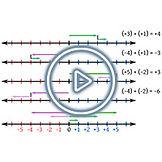
Master addition and subtraction of integers using the number line to visualize movement (right for +, left for -). Learn the critical rules for combining signs (e.g., 3 - (-6) = 3 + 6) and how to use the additive inverse concept (e.g., -13 + 21) for mental math with larger numbers. This video provides step-by-step problem-solving techniques for working with positive and negative numbers, essential for building strong foundational skills in algebra and arithmetic
Essential skills for Grade 8 and 9 mathematics! This comprehensive lesson covers the Order of Operations (BODMAS/PEMDAS) when working with integers (positive and negative numbers) and exponents. We refresh the foundational sequence and provide advanced practice on correctly handling expressions with:
-
Brackets and simplifying terms.
-
Order/Exponents (powers and roots).
-
Sign Rules for multiplication and division of negative numbers.
-
Identifying and solving multi-term expressions separated by addition/subtraction.
This is a critical topic for algebraic readiness and success in the CAPS, IEB, and IGCSE curricula
Exponents

Master essential Grade 8/9 Exponent Laws quickly! Learn to apply the Product Rule, Quotient Rule , and Power-to-a-Power Rule to simplify expressions with positive and negative exponents. Crucial for success in CAPS, IEB, and IGCSE algebra. #ExponentLaws #Grade8Math #Algebra #IGCSE #CAPS
Algebraic Expressions

Master the essential skill of collecting like terms in algebra. Learn to correctly identify terms with the same variables and exponents (e.g., x^2 vs x), simplify complex expressions involving addition, subtraction, multiplication, and division, and solve word problems. Crucial foundation for Grade 8 & 9 curriculum success across CAPS, IEB, and IGCSE

The video provides a thorough explanation of how to simplify roots with monomials, focusing on the connection between root form (radical) and exponential form. This topic is highly relevant for Grade 8 and 9 students across CAPS, IEB, and IGCSE math curricula as it solidifies the understanding of exponents and algebraic manipulation.
Algebraic Equations

Master solving linear algebraic equations! Learn essential techniques like using additive and multiplicative inverses (the inverse operation/carrying over) to isolate the unknown variable. This video covers:
-
One- and two-step equations.
-
The distributive law in equations.
-
Equations with fractions.
-
Handling variables on both sides.
Essential skills for Grade 8 & 9 algebra success in CAPS, IEB, and IGCSE

Master nonlinear equations—those with a variable order greater than one (quadratic) or a variable in the exponent (exponential). This Grade 8/9/10 video teaches you how to solve non-linear equations using both inspection and algebraic methods.Quadratic Equations (x^2 = k): Solve by using the square root property and remembering the (plus/minus) rule.Exponential Equations (b^x = k): Solve by rewriting terms to have the same base (e.g., 8 = 2^x).Solving equations involving roots and cubes.Essential techniques for CAPS, IEB, and IGCSE mathematics
Fractions

Master the different types of fractions! This video clearly explains the definitions, components (numerator and denominator), and real-world meaning of a fraction as a portion of a quantity.You will learn to:Identify proper fractions (value between 0 and 1) and improper fractions (value greater than 1).Convert between improper fractions and mixed numbers (including negative values).Find the Highest Common Factor (HCF) to simplify fractions and create equivalent fractions .Find the Lowest Common Denominator (LCD) to order fractions .Visualize and reason with fractions as parts of shapes and on a number line.Perfect for students in Grade 8 or 9 looking to build a strong foundation in arithmetic and algebra

Start mastering fraction arithmetic! This video covers the simplest case: adding and subtracting fractions that already have the same denominator. Learn the quick rule: simply add or subtract the numerators and keep the denominator constant
Properties of 2-D Shapes

Master the essential vocabulary and angle classifications needed for your 2D shapes in geometry! This video covers fundamental terms for triangles and quadrilaterals, including:Complementary and Supplementary angles,2D Shapes and Polygons,Perpendicular and Parallel lines.Classifications of angles: Acute , Right, Obtuse , and Reflex .Build strong deduction skills to succeed in visual geometry problems necessary for grade 8 and 9 Geometry in the CAPS, IEB AND IGCSE curricula

Master 2D Geometry! This video introduces Quadrilaterals, which are simply four-sided closed shapes. We define the key properties they all share (four sides, four angles, two diagonals) and begin the process of classification. Learn the fundamental differences between the main types: parallelograms, trapeziums, and kites
Area, Perimeter and Volume

Master the foundational theory for calculating the surface area and volume of 3D prisms! This video defines key terms and concepts in geometry:
-
Prisms: Identify prisms using their two opposite, congruent faces.
-
Surface Area: Understand it as the combined area of all faces (exposed and hidden).
-
Volume: Learn the "stacking method" to conceptualize volume and why units are cubed .
-
Nets: Define nets as 2D configurations that fold into 3D shapes.
-
Non-Prisms: Understand why cylinders and pyramids are not prisms.
A crucial theoretical lesson for working with 3D object calculations

Master the calculation of area and perimeter for triangles in this comprehensive guide! We start with the fundamental area formula (1/2)*base*height emphasizing the crucial role of perpendicular height.The video covers detailed examples on:Using Pythagoras to find missing sides in right-angle triangles.Applying properties of isosceles triangles (perpendicular bisector).Calculating area and perimeter for compound shapes (rectangles + triangles).Solving algebraic problems by finding area/perimeter in terms of x.Working backwards from a known area to determine a missing base or perpendicular height.Essential geometry skills for intermediate level mathematics for grade 8 and 9 learners doing the CAPS. IEB and IGCSE Curricula
Get The Most Out of Our Free Resources!
CAPS AND IEB ALIGNED
South-Africa-First Approach!
Our material is drafted in accordance with with National Curriculum Assessment Policy Statements for South Africa. Leaners doing the CAPS and IEB curricula may benefit from universal and localised concepts covered in our videos/resources
FREE SUPPORT
Comment On Videos - Get Free Assistance!
To give learner the upper-hand, we encourage comments and reactions on our videos. The comment section is managed by our staff and all learners requiring assistance will receive a public response which other users may benefit from
TUTOR-LED


You're In Good Hands!
Our videos are pre-recorded, in-depth tutor-led lessons covering the most fundamental components of each topic in the curriculum. Our videos are also subject to routine audits by the Department of Basic Education
Resources FAQ
Which curriculum is the material best suited for?
Our material is drafted in alignment with the Curriculum Assessment Policy Statements (CAPS) and is also suitable for learners doing the IEB curriculum and Cambridge IGCSE
Can I get extra assistance for concepts covered that I still do not understand?
The best part of our free resources is the ability to comment on timestamped points on the videos. Our comments section is monitored by our staff and users who require genuine assistance will receive a public response visible to all other viewers. Alternatively, you may consider subscribing to our full premium course which comes complete with tutor support during your membership. You can view the available options here
Are the resources supplements for classroom material?
No, our resources are intended for enhancement purposes. We recommend that classroom material be given first preference and that our resources be used complementary to classroom material
Do I need a membership to benefit from the resources?
Absolutely not. Our resources listed on this page is available to the public and is free from any charges by Tutors Inc. SA. Do note that this page is not zero-rated so internet service providers may charge a fee for network use (airtime or data)
Is Tutors Inc. SA Affiliated with the Department of Basic Education?
No, we are not. We have collaborated with the DBE and sponsored material to the users visiting the website of the DBE in an effort to make high quality material accessible to learners who may benefit from it the most.
Website Usage Disclaimer
This resource portal may have access to geographic and usage data which will be processed to improve our content and other relevant resources/services provided by Tutors Inc. SA and its subsidiaries. Usage data may be occasionally shared with the Gauteng Department of Basic Education in an effort to refine the South African education system. You may access our broad privacy policy here